
Institution: University of Ibadan Department: Department of Law and Department of Arts and Social Sciences Education
Student ID Number: 235968, 242439
Email Address: divineakachukwu06@gmail.com, waleadeyemiinioluwa@gmail.com Phone Number: 07085253642, 09169858970
ABSTRACT The social contract assumes both parties will honour their obligations. In Nigeria, citizens have upheld their end for decades. The state is only beginning to fulfil its. For decades, dependence on oil revenue, institutional neglect, and administrative failure have eroded tax compliance and entrenched evasion. Nigeria’s tax-to-GDP ratio of 9.5 per cent in 2023 barely half the African continental average, is the arithmetic expression of that failure. The 2025 Tax Reform Acts, operational since January 2026, represent the most structurally ambitious fiscal intervention in Nigeria’s post-independence history, shifting the system’s philosophical foundation from coercion to voluntary engagement. This essay analyses Nigeria’s shift through three theoretical lenses which are Allingham and Sandmo’s deterrence framework, Kirchler’s Slippery Slope, and the OECD Tax Morale model before tracing the country’s compliance history from post-independence enforcement to the current reform phase. Global comparisons with Rwanda, Estonia, and the United Kingdom demonstrate that voluntary compliance is achievable when simplicity, citizen incentives, and visible accountability converge. Nigeria’s 2026 reforms address simplicity; the trust deficit remains the unresolved barrier. The essay concludes with four recommendations: a nationwide youth tax literacy movement anchored in university clubs; a blockchain-based Tax Trust Ledger allowing citizens to track their tax contributions in real time; Rwanda-style citizen reward incentives; and USSD-based simplified filing for the informal sector. When every Nigerian sees their tax working for them, compliance will be chosen and not compelled.
INTRODUCTION
Locke and Rousseau conceived of taxation as a social contract where citizens give up certain economic freedom in return for government protection and public services. In Nigeria, citizens have been performing that obligation for decades, waiting mostly in vain for the state to honour its side. This persistent negligence has made people lose trust in compliance and given birth to widespread apathy and evasion. The government has since started addressing these failures, initiating a new phase of taxation whose ambition is matched only by the scale of the challenge it inherits. Nigeria’s shift from enforcement to engagement represents one of the most significant fiscal pivots in its post-independence history. It is, however immediately tested by a deep trust deficit, entrenched informality, and a social contract the government must now honour. This essay is guided by three questions: Does government accountability accompany the clarity of tax burden assigned to respective brackets? What are the major objectives of these reforms, and how achievable are they? How capable is this tax system of sustaining long-term economic stability? These questions are not purely academic as they are informed by decades of Nigerian underperformance on macroeconomic reforms of comparable goals. CONCEPTUAL FRAMEWORK Three theoretical lenses ground this analysis. Allingham and Sandmo (1972) reduced compliance to a rational calculation, a taxpayer complies only when the expected cost of evasion, measured by audit probability and penalty magnitude, outweighs the benefit of non-declaration. This deterrence logic characterised Nigeria’s post-independence enforcement approach. It collapsed in practice, however: with 57 to 80 per cent of economic activity occurring informally, audit probability was effectively negligible, rendering the deterrence calculation meaningless for the majority of economic actors. Kirchler, Hoelzl, and Wahl (2008) identified what deterrence theory missed: trust. Their Slippery Slope Framework argues that compliance rests on two pillars — the power of tax authorities and citizens’ trust in them. Table 1 shows the outcome of each combination:
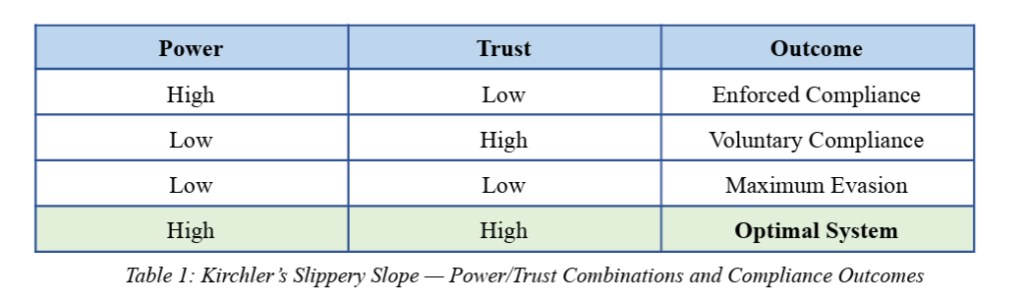
Nigeria has historically occupied the first and third quadrants, escalating enforcement while neglecting trust — producing widespread and creative evasion. The 2026 reforms represent the first deliberate attempt to advance both axes simultaneously. The OECD Tax Morale framework (2019) introduces the human dimension, which is, the intrinsic willingness to pay taxes not through coercion, but from conviction in the greater social good. This aligns with Bentham and Mill’s utilitarian argument that taxation is justified when it produces the greatest good for the greatest number. When that benefit is invisible, the moral justification collapses. In Nigeria, where formal enforcement cannot reach most economic actors, tax morale is not a peripheral consideration — it is the primary compliance mechanism available. NIGERIA’S ENFORCEMENT LEGACY Nigeria’s tax system was structurally neglected from its post-independence foundations not through deliberate design, but through the complacency that oil wealth enables. Federal revenue dominated by petroleum receipts left little political incentive to build administrative capacity or a compliance culture. When oil prices crashed, governments turned to the tax system for stabilisation but found no established foundation. The result was a tax-to-GDP ratio of 9.5 per cent in 2023 barely half the African continental average of 16.1 per cent (OECD/ATAF/AUC, 2025) and less than one-third of the OECD benchmark of 34 per cent. The informal sector, accounting for 57 to 80 per cent of Nigeria’s economic activity (NBS; World Bank, 2023), rendered enforcement structurally blind, as you cannot audit what you cannot see. Taiwo Oyedele, Chairman of the Presidential Fiscal Policy and Tax Reform Committee, described the consequence as a “colossal trust deficit” between taxpayers and government institutions (PwC Nigeria, 2025), reflecting the accumulated damage of decades of corruption and poor service delivery. Afrobarometer surveys, cited in the OECD Tax Morale Report (2019), confirm the pattern: as corruption perceptions rise, tax compliance falls sharply. Overlapping federal, state, and local levies compounded the problem, punishing willing taxpayers alongside evasive ones (Ariyo, 1997; World Bank, 2023). The 2026 Tax Reform Acts must be understood against this backdrop, not as routine adjustment, but as an attempt to rebuild a fiscal system from its foundations. THE REFORM SHIFT The central question is whether Nigeria’s shift is genuine or merely enforcement rebranded. Drawing on Kirchler’s framework, the answer is: partially genuine. Nigeria’s first significant engagement attempt, the Voluntary Assets and Income Declaration Scheme (VAIDS) of 2017, recovered approximately ₦94 billion in previously undisclosed liabilities (FIRS, 2018). VAIDS is best understood, however, as enforced compliance redesigned, its voluntary character derived not from intrinsic motivation but from the implicit threat of prosecution facing those who declined. It collected revenue; it did not build a compliance culture. The Finance Acts of 2019 through 2023 represented incremental but meaningful progress. The 2019 Act’s exemption of companies with annual turnover below ₦25 million from Companies Income Tax marked the first deliberate use of tax relief as a compliance incentive, while successive Acts expanded digital infrastructure and empowered the FIRS to automate collection, laying the technical foundation for what followed. The four Tax Reform Acts signed in June 2025, effective January 2026, constitute the most structurally significant fiscal intervention in Nigeria’s post-independence history. Their provisions address compliance barriers across three dimensions. On relief: companies with turnover below ₦50 million now pay zero Companies Income Tax, zero Capital Gains Tax, and zero Development Levy, directly incentivising formalisation; VAT is zero-rated on food, medicine, books, electricity, and tuition, a recognition that compliance cannot be demanded from citizens whose basic necessities carry a tax burden. On simple terms, multiple overlapping levies are consolidated into a single 4 per cent Development Levy, eliminating the complexity that penalised willing taxpayers (PwC Nigeria, 2025; KPMG Nigeria, 2025). On digitalisation: mandatory e-invoicing through TaxPro-Max and simplified returns for the informal sector reduce compliance costs; 182,724 voluntary registrations were recorded through TaxPro-Max in 2024 alone (FIRS, 2024). These reforms are barely two months old. Their promise is structural; their proof is still pending. KPMG’s January 2026 review identified implementation gaps requiring legislative fine-tuning (KPMG Nigeria, 2026). Whether citizens will trust the new system enough to comply voluntarily, rather than strategically, remains the defining question of Nigeria’s fiscal year 2026.
GLOBAL PERSPECTIVES ON VOLUNTARY TAX COMPLIANCE
Global experience shows that the transition from enforcement to engagement is driven by three consistent enablers: simplicity, visible accountability, and citizen-centred incentives. Rwanda’s experience is particularly instructive because it demonstrates that this transition is achievable within a developing African economy. The Rwanda Revenue Authority’s Electronic Billing Machine system transmits invoices in real time, while a consumer reward programme offers 10 per cent VAT cashback to buyers who demand valid receipts and 50 per cent of penalties to citizens who report non-compliant businesses (RRA, 2023). Compliance becomes personally beneficial rather than merely legally obligatory as voluntary compliance rose 15 per cent and revenue collections exceeded targets at 101.4 per cent in 2024/25. Nigeria has introduced mandatory e-invoicing through TaxPro-Max; what is absent is Rwanda’s motivation architecture which entails tangible citizen rewards that make compliance rewarding, rather than merely required. Estonia sets the technology benchmark. With 99 per cent of declarations filed digitally and returns pre-filled from third-party data, filing takes minutes and the tax gap sits consistently below 5 to 7 per cent (OECD, 2023). Nigeria’s TaxPro-Max moves in this direction but still requires self-reporting — a critical distinction in a country with significant financial literacy barriers. The United Kingdom adds the behavioural dimension. HMRC’s Making Tax Digital mandates digital record-keeping, while its behavioural insights unit deploys social norm messaging like informing taxpayers that peers in their area pay on time and producing a tax gap of just 5.3 per cent in 2023–24 at minimal cost (HMRC, 2024). In a collectivist society like Nigeria, such nudges could carry considerable weight. Together, these cases point to a clear conclusion: Nigeria’s 2026 reforms address simplicity. Visible accountability and citizen incentives, the two remaining pillars, are still absent.
CHALLENGES TO VOLUNTARY TAX COMPLIANCE IN NIGERIA
Nigeria’s shift towards voluntary compliance faces structural barriers that decades of institutional failure have embedded deeply, and which legislation alone cannot rapidly dissolve. The most fundamental barrier is the trust deficit which happens when citizens cannot trace a visible connection between taxes paid and services received such as when roads remain unpaved, hospitals understocked, and public funds misappropriated, the moral justification for compliance collapses. Oyedele’s “colossal trust deficit” (PwC Nigeria, 2025) is the central obstacle the 2026 reforms must overcome, and Afrobarometer data confirms it is systemic across Sub-Saharan Africa (OECD, 2019). Structural informality compounds this challenge. With 57 to 80 per cent of Nigeria’s economic activity outside formal records (NBS; World Bank, 2023), voluntary compliance strategies built around digital platforms cannot reach their intended audience. TaxPro-Max assumes internet access, financial literacy, and formal business registration — conditions that exclude the majority of Nigeria’s economic actors. Multiple taxation persists at state and local levels despite federal harmonisation. Citizens who experience the tax system as predatory rather than reciprocal will not voluntarily engage with it, and this directly undermines the tax morale the 2026 reforms are attempting to build (Ariyo, 1997; World Bank, 2023).
CONCLUSION & RECOMMENDATIONS
Nigeria’s shift from enforcement to engagement is genuine in legislative ambition but unproven in citizen experience. The 2026 Tax Reform Acts have correctly diagnosed the compliance crisis, a regressive burden on small businesses, administrative complexity, digital exclusion, and a broken social contract. The prescription is sound. The missing variable is trust, and trust is not legislated; it is earned through visible, consistent, and accountable delivery. First, a nationwide youth tax literacy movement anchored in university tax clubs should be leveraged since structured programmes targeting one million youths over two years would build tax morale from the bottom up, as Rwanda’s community campaigns have demonstrated. As Director of Research at the University of Ibadan Tax Club, this is a pillar this institution is positioned to lead. Second, a Tax Trust Ledger should be launched, that is, a blockchain-based transparency mechanism through which citizens enter their Tax Identification Number and immediately see what their tax contributions have funded in their community, with monthly public dashboards published in Pidgin, Yoruba, Hausa, and Igbo. This directly addresses the trust deficit that Kirchler’s framework identifies as the missing axis. Third, Rwanda-style citizen reward incentives should be introduced — 5 to 10 per cent airtime or cashback for citizens who demand e-invoices and file correctly through TaxPro-Max, converting compliance into a personally rewarding act. Fourth, Unstructured Supplementary Service Data (USSD)-based simplified filing should be deployed, supported by accessible training campaigns for the informal sector. A USSD channel requires only a basic mobile phone, reaching traders and artisans where they operate. When every Nigerian sees their tax visibly working for them, voluntary compliance will not need to be mandatory, it will be chosen.
REFERENCES
Allingham, M. G., & Sandmo, A. (1972). Income tax evasion: A theoretical analysis. Journal of Public Economics , 1 (3–4), 323–338. https://doi.org/10.1016/0047-2727(72)90010-2 Ariyo, A. (1997). Productivity of the Nigerian tax system: 1970–1990 . African Economic Research Consortium Research Paper 67. Federal Inland Revenue Service. (2018). VAIDS implementation report . FIRS. https://www.firs.gov.ng Federal Inland Revenue Service. (2024). TaxPro-Max voluntary registrations data . FIRS. https://www.firs.gov.ng HMRC. (2024). Making Tax Digital: Overview and compliance data . HM Revenue & Customs. https://www.gov.uk/government/organisations/hm-revenue-customs Kirchler, E., Hoelzl, E., & Wahl, I. (2008). Enforced versus voluntary tax compliance: The “slippery slope” framework. Journal of Economic Psychology , 29 (2), 210–225. https://doi.org/10.1016/j.joep.2007.05.004
KPMG Nigeria. (2025). The Nigeria Tax Administration Act (NTAA) 2025 . KPMG. https://kpmg.com/ng/en/home/insights/2025/06/the-nigeria-tax-administration-act-ntaa-2025. html KPMG Nigeria. (2026, January). Inherent errors, gaps and omissions in new Tax Acts . KPMG. https://assets.kpmg.com/content/dam/kpmg/ng/pdf/2026/01 OECD. (2019). Tax morale: What drives people and businesses to pay tax? OECD Publishing. https://doi.org/10.1787/f3d8ea10-en OECD. (2023). Tax administration 2023: Comparative information on OECD and other advanced economies . OECD Publishing. https://doi.org/10.1787/900b6382-en OECD/ATAF/AUC. (2025). Revenue statistics in Africa 2025 . OECD Publishing. https://doi.org/10.1787/8d3bf3af-en PwC Nigeria. (2025). The Nigerian Tax Reform Acts . PwC. https://www.pwc.com/ng/en/publications/the-nigerian-tax-reform-acts.html Rwanda Revenue Authority. (2023). RRA annual report 2022/23 . RRA. https://www.rra.gov.rw World Bank. (2023). Nigeria economic update: Fiscal consolidation for better services . World Bank Group. https://www.worldbank.org/en/country/nigeria